Intro to Ultra Racing
Meaghan Hackinen shares her insight into getting started in ultra racing.
Words By: Meaghan Hackinen


I remember one afternoon during the Trans Am Bike Race, holed up in a pizza parlour in Ennis, Montana, drinking light beer whose only redeeming quality was that it was cold with two European riders while our laundry spun next door at the laundromat. We were sweating in our rain gear (the only clothing we had left), commiserating about diabolical headwinds and hatching a plan to hunker down for a few hours in a nearby motel room before pushing east into Yellowstone after dark.
That was 2017.
I was an experienced cycle tourist, but still green when it came to ultra racing, and the moment surprised me. I’d expected a solitary sufferfest defined by fierce competition and barely a moment to think. Instead, I found camaraderie, improvisation, and an obsessive attention to weather systems.
Scarfing down another slice of greasy pepperoni pizza in Ennis, I began to realize ultra racing wasn’t quite what I thought it was.


Ultra racing generally refers to multi-day endurance cycling events, which fall into two categories: supported and self-supported (or unsupported).
In supported events, riders have a crew handling logistics like food, navigation, mechanical support, and sleep setup. The best-known example is the Race Across America (RAAM). On the self-supported side, riders manage everything themselves while moving independently through the route. My own first ultra, the Trans Am Bike Race, would be considered the unsupported counterpart to RAAM.
I’m focusing here on self-supported racing, partly because it’s what I know best, but also because it’s more accessible: wider event opportunities, no crew required, and a strong DIY ethos.

In self-supported ultra racing, riders are responsible for navigation, resupply, repairs, sleep strategy, and all decision-making. Some events follow fixed routes, while others, like the Transcontinental Race in Europe, allow riders to choose their own path between checkpoints. Riders carry GPS trackers for live tracking, and instead of course officials, they follow a code of honour: no drafting, cutting corners, or outside support.
A few common myths don’t ring true for me:
- Ultra racing is not nonstop suffering.
- It’s not always lonely.
- And it’s definitely not reserved for athletes with elite-level fitness.
Sleep deprivation is part of the equation, but the evidence, both anecdotal and scientific, suggests that more sleep generally means better riding (though I’ve admittedly been guilty of cutting sleep in an effort to make up time). More often, success comes down to adaptability, consistency, and a willingness to keep moving through uncertainty.

People arrive at ultra racing for different reasons. For some, it’s the simplicity. For others, it’s an escape. For many, I suspect, it has to do with the curiosity of finding physical limits, testing mental resilience, and discovering what happens when you spend an extended amount of time moving through a landscape under your own power.


For me, my drive for ultra racing comes from both a desire for competition and immersion. All my life, I’ve needed a competitive outlet, and I love traversing wild places by bike—why not combine the two? I also appreciate the clarity that emerges after several days outside in pursuit of a single goal. Things we often take for granted, like the emerald green of everything after a storm, a kind word from a stranger, or a dry place to sleep, suddenly mean more. On a particularly rough morning in Virginia during the Trans Am, I nearly burst into tears when another racer handed me a mug of hot coffee. In that moment, it felt like the kindest thing anyone had ever done for me; it was exactly what I needed.


The last few years have seen an explosion of bikepacking events, which raises the question: with so many ultras to choose from, how do you pick?
Terrain, remoteness, navigation complexity, resupply frequency, and event culture all shape the experience. A mountainous gravel route through remote terrain feels very different from a road route with frequent towns and simpler logistics. Some riders thrive in highly competitive environments, while others are looking for adventure, self-discovery, or community. Similarly, some riders might prefer accessible ultras close to home, while others may use the experience as an excuse to travel to a far-flung corner of the world.
One common mistake is choosing an event based purely on prestige or difficulty rather than personal fit. When I started ultra racing in 2017, there were only a handful of events to choose from, and road riding was all I knew. Though the Trans Am captured my imagination, I doubt I’d jump straight into a 6,800-kilometre race if I were starting today. That being said, I did learn something, and I think that can be said for nearly any experience that feels imperfectly executed.


Ultra racing generally rewards durability more than peak fitness. Consistency, injury prevention, and the ability to recover while steadily accumulating miles trump impressive watts-per-kilogram numbers. In my own training, I intersperse high-intensity intervals with zone two riding and longer days, adding some big back-to-back rides in preparation for races. For newer riders, getting comfortable with navigation, night riding, and learning how your body responds to fatigue are all useful preparation.
Mental preparation matters just as much as the physical. During a multi-day effort, your emotional state can swing wildly between boredom, contentment, frustration, confidence, doubt, and overwhelming joy. One of the most valuable skills is learning not to catastrophize: you’ll feel low, your bike will break down, and you won’t always hit your targets as planned. Instead of spiralling, I try to focus on the next task. What can I do right now to improve my situation?
Finally, there’s the logistical prep (probably my least favourite part). Ultra racing involves constant decision-making around resupply, pacing, sleep, weather, and timing. Approaches vary widely: between Justinas Leveika’s “King of Chaos” style and Ulrich Bartholmoes’ hyper-scientific approach, you’ll find that most riders sit somewhere in between, putting in the time to study routes, identify resupply points, and build plans before the event even begins. Tools like Ride with GPS, Epic Ride Weather, and a playlist of surefire pick-me-up tunes to keep you jamming through the night help reduce mental load and keep spirits high once fatigue starts accumulating.


In ultra racing, reliability and simplicity are paramount, especially once sleep deprivation enters the picture. One of the biggest mistakes newer riders make is overcomplicating things. Every system on your bike should be something you understand well and have tested thoroughly before race day—from your bike setup and storage system to your repair kit, sleep system, and clothing. Durable, adaptable gear tends to outperform overly specialized setups when conditions inevitably change.
On my first ultra, the Trans Am Bike Race, I tried to cut some precious grams by opting to bring rain chaps instead of full rain pants. They were neon yellow but utterly useless. I suspect they were designed for short commutes with fenders.
That decision came back to haunt me at the top of Togwotee Pass in Wyoming, just beyond Yellowstone and the Grand Tetons, where I pulled them on in a snowstorm. My European riding companions could hardly contain their laughter. Minutes later, as the snow turned to driving rain and I felt everything underneath become saturated, I had a very clear, cold realization that I’d packed the wrong gear.


Weather Ready Layering
As demonstrated above, clothing becomes part of your overall comfort and survival system in multi-day racing. Conditions can change quickly, especially in the mountains, where riders move through major temperature swings over the course of a single afternoon.
Layering allows you to adapt without carrying excessive bulk. Breathable riding layers, insulating pieces for descents and night riding, and reliable waterproof protection all work together as part of a broader system.
For instance, I used the Atlas jersey for each of last season’s Mountain Races (Atlas in Morocco, Hellenic in Greece, and Silk Road in Kyrgyzstan), then added a S2S vest, Colorado arm warmers, and neck warmer as night approached. If temperatures continued to drop, I layered on the Hollyburn tight and a jacket. I sleep in the Ashlu merino sleeveless base layer and on colder days, I’ll often wear it under my jersey to extend the range of my riding kit without adding bulk.
Waterproof layers matter more than many riders initially expect. Staying dry isn’t always possible, but staying functional is. As someone who struggles with the cold, solid rain gear, warm layers, and clothing that continues performing after repeated wear can make a huge difference to both morale and safety during long events.
In the harsh conditions of last year’s Silk Road Mountain Race, my Skypilot jacket became a constant companion through snowstorms and sub-zero temperatures. I trusted it to hold in core warmth even during long, exposed sections at altitude and midnight river crossings. The hood was especially valuable, a small detail that made a big difference in retaining heat when much of my body was wet, cold, and moving slowly.
Meaghan's Essentials


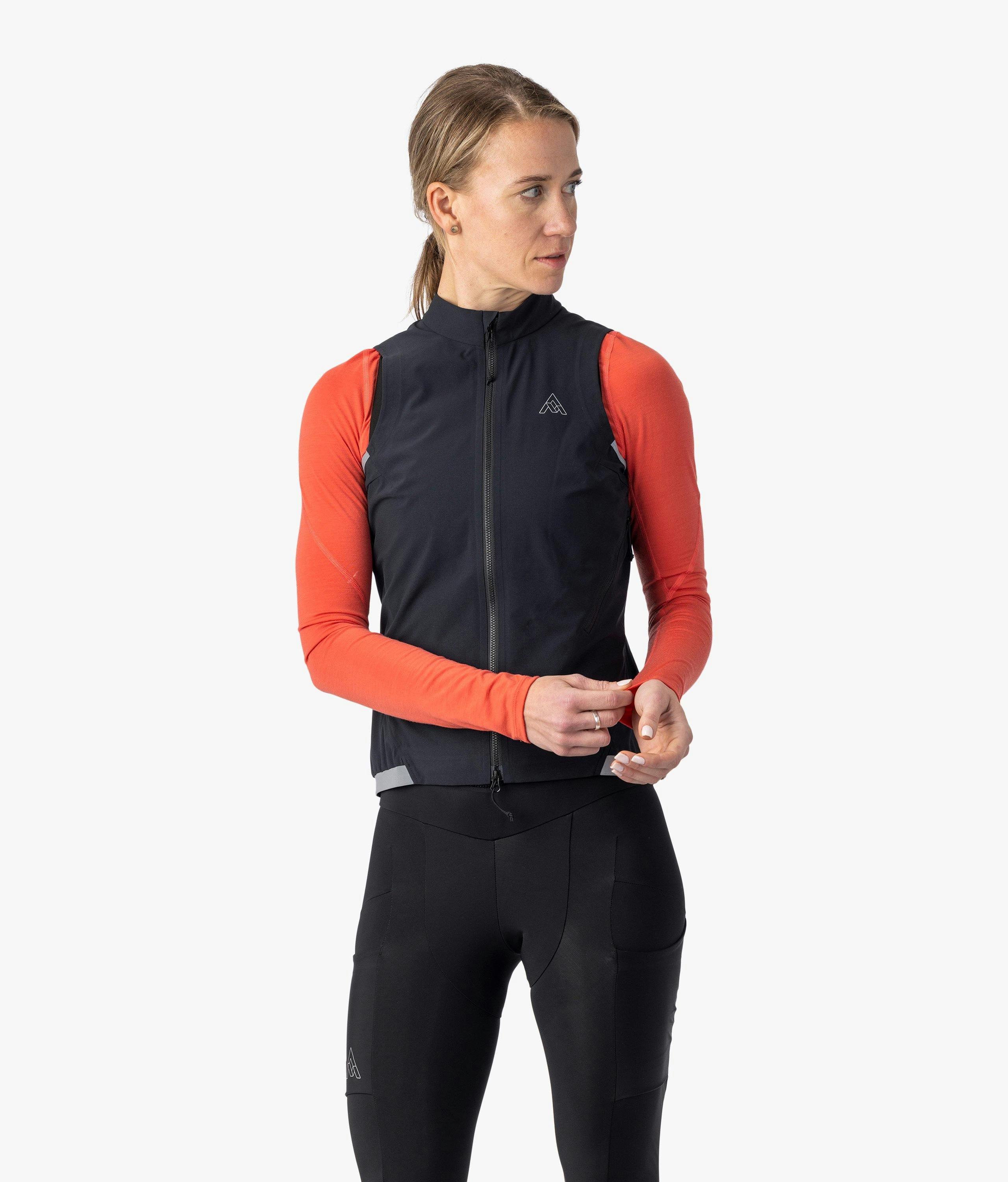


The good news is you don’t need to jump directly into a transcontinental race to begin exploring ultra riding. Overnight rides, local gravel loops, and short self-supported trips are all paths toward the same core skills: pacing, fueling, navigation, layering, problem-solving, and adapting to changing conditions. There’s also room for every kind of racer—from the record chasers to the party pacers. Racing can mean something different to everyone, and no one but you gets to define what your version of it looks like.
You also don’t need to feel perfectly prepared before starting. In fact, most ultra racers are constantly learning and adjusting. Every ride reveals something new about systems, mindset, gear, and personal limits. Experience accumulates gradually—and mistakes can sometimes teach us more than getting it right the first time around.


My body was broken after the Trans Am Bike Race. After 24 days and 22 hours, all I wanted to do was sleep. But within a few days, life came back to me. My swollen knees settled back into their familiar shape, dexterity returned to my fingertips, and I began to process the enormity of what I’d done. I was hooked.
I’ve been racing ever since. And even though a part of me occasionally wonders if I should be done with it, I keep coming back. There’s always more to discover. I’ve made fast friends, fallen in love, and gained a better understanding of myself through racing.
Ultra racing has taught me to accept uncertainty and get comfortable with discomfort; how to problem-solve under fatigue, and how little I actually need in order to feel content. After a few days on the bike, life becomes distilled into basic elements: movement, food, road conditions, rest.
